


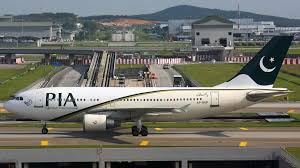
Pakistan International Airlines (PIA), once hailed as a regional aviation pioneer, today stands as a reflection of the country’s deepening institutional decay.
The airline that helped launch other national carriers in Asia and the Middle East now struggles to keep its own planes airborne. Flight delays, unpaid salaries, and safety protests have become routine headlines—signs of a flag carrier that has lost not just altitude but direction.
The latest turmoil began when engineers from the Society of Aircraft Engineers of Pakistan (SAEP) launched a protest over pay disparities and mounting safety concerns.
What began as silent dissent, marked by black ribbons tied to arms, soon evolved into a full-blown crisis that grounded flights nationwide.
Passengers—hundreds of them bound for Saudi Arabia and other destinations—were left stranded for hours, as engineers refused to sign off on airworthiness certificates.
For a national carrier already burdened by debt and inefficiency, the protest could not have come at a worse time.
According to SAEP representatives, their grievances stem from years of neglect. While pilots have received periodic salary revisions, engineers allege that their pay has remained stagnant for nearly a decade.
Beyond financial injustice, they have also raised alarming concerns over safety. Engineers claim they have been repeatedly asked to reuse old or worn-out aircraft parts—an instruction they argue directly compromises passenger safety.
Their refusal to comply triggered the management’s wrath, culminating in the suspension and dismissal of key union leaders.
PIA’s management, however, maintains that the protest was “illegal” and politically motivated. In a statement, the airline accused SAEP of attempting to “sabotage” the government’s ongoing privatisation process.
The Essential Services Act, which prohibits strikes in critical sectors, has been invoked to justify disciplinary action. Yet, beneath the legal posturing lies a deeper crisis—an airline long caught between political interference, mismanagement, and chronic financial insolvency.
PIA’s woes are not new. The airline, once a source of national pride, has been accumulating losses for years, now estimated at more than $2.5 billion. Its fleet is ageing, its operations erratic, and its reputation battered.
From flight cancellations to safety bans imposed by international aviation regulators, PIA’s decline has been relentless.
Once a regional leader that trained pilots for Emirates and Singapore Airlines, it has become a cautionary tale of how state enterprises collapse when run on political patronage rather than professional merit.
The ongoing dispute with engineers underscores how systemic the decay has become. Engineers play an indispensable role in aviation safety—no aircraft can take off without their sign-off. Their refusal to certify planes has brought operations to a near standstill.
After 8 pm on November 3, not a single PIA international flight took off — this is a stark illustration of how fragile the airline’s infrastructure has become. What should have been a technical disagreement has instead evolved into a national embarrassment.
The engineers’ safety concerns are not unfounded. Earlier this year, a PIA flight bound for Jeddah had to return to Lahore mid-air after its windshield cracked. Engineers claim they had warned the management about the aircraft’s condition, but their advice was ignored.
For passengers and crew, it was a terrifying reminder of the growing safety risks within Pakistan’s aviation sector. Incidents like these not only erode public trust but also damage Pakistan’s standing in international aviation circles, already weakened by earlier scandals involving fake pilot licenses and regulatory lapses.
The dismissals of SAEP President Abdullah Jadoon and Secretary-General Awais Jadoon have further fuelled resentment within the ranks.
The management accused them of leaking confidential information and conducting unauthorised press conferences, while the engineers say they are being punished for speaking the truth.
Their removal has deepened the divide between workers and the administration, with SAEP vowing to challenge the dismissals in court. The resulting standoff has left flight operations crippled and the airline’s image further tarnished.
PIA’s crisis, however, is symptomatic of Pakistan’s broader aviation meltdown.
The Civil Aviation Authority (CAA), which oversees the sector, has been under fire for regulatory lapses and corruption.
After the 2020 crash of PIA Flight PK8303, global regulators discovered that nearly one-third of Pakistani pilots had suspicious or fraudulent licenses.
The European Union Aviation Safety Agency (EASA) responded by banning PIA from flying to Europe, a ban that remains largely in place. Efforts to restore credibility have faltered amid continued mismanagement and bureaucratic inefficiency.
The deterioration of Pakistan’s aviation infrastructure mirrors the larger economic and institutional breakdown gripping the country. Once considered a key transport hub in South Asia, Pakistan is now struggling to maintain even domestic connectivity.
Airports operate on outdated technology, fuel shortages have disrupted schedules, and foreign airlines have reduced operations, citing financial instability.
Even as the government seeks to privatise PIA, few investors are willing to take on an airline weighed down by debt, corruption, and political meddling.
The privatisation drive itself has become controversial. The government claims it is essential to save the national carrier, but unions and employees fear mass layoffs and loss of job security.
Critics also question whether privatisation, without deep structural reforms, can rescue a system plagued by inefficiency.
For decades, PIA has served as a political tool—used to reward loyalists with jobs and contracts, regardless of competence. The result is an organisation bloated with excess staff, crippled by bureaucracy, and detached from market realities.
Meanwhile, the public continues to pay the price. Stranded passengers, delayed flights, and compromised safety have become the new normal.
Even religious pilgrims—once a core segment of PIA’s clientele—now prefer foreign airlines for reliability. The national carrier, which once carried Pakistan’s flag with pride across continents, now struggles to maintain basic flight schedules within its own borders.
The image of grounded aircraft at Karachi and Lahore airports serves as a stark metaphor for the state of the nation itself—immobilised by internal conflict, weakened by corruption, and abandoned by leadership.
What began as a technical dispute over wages and spare parts has laid bare the fragility of Pakistan’s governance and its inability to sustain essential institutions.
PIA’s decline is more than just an airline’s failure—it is the story of Pakistan’s shrinking capacity to manage its own public enterprises responsibly.
The very engineers now protesting were once part of a system that symbolised progress and national pride. Today, their struggle reflects a country where even the skies are no longer free from turbulence.