


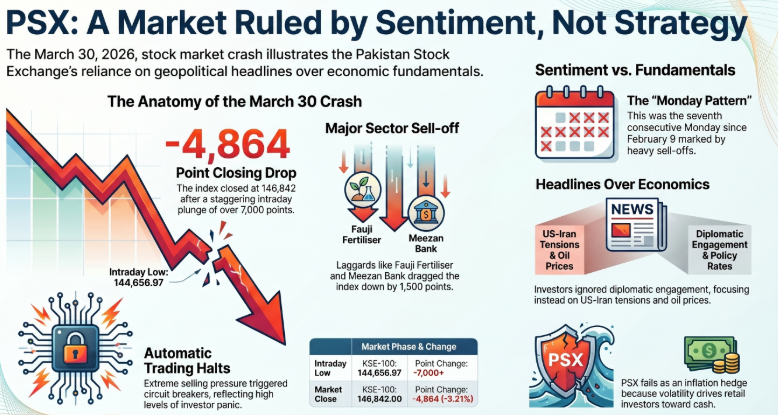
On Monday, March 30, 2026, the Pakistan Stock Exchange (PSX) endured one of its sharpest downturns in recent memory, underscoring a persistent truth about the market: it is driven less by fundamentals and more by investor sentiment shaped by political and geopolitical developments.
From the opening bell, the benchmark KSE-100 index was under extreme selling pressure, plunging more than 7,000 points intraday to 144,656.97 before recovering slightly to close at 146,842, still down 4,864 points (-3.21%). The sheer scale of the decline triggered automatic trading halts as circuit breakers were hit, reflecting the panic coursing through the market. Heavyweights such as Fauji Fertiliser, Engro Holdings, Meezan Bank, Lucky Cement, and United Bank acted as key laggards, collectively dragging the index down by over 1,500 points.
The timing of the crash was telling. On the same day, President Asif Ali Zardari chaired a high-level meeting at Aiwan-e-Sadr with Prime Minister Shehbaz Sharif, federal ministers, military officers, and provincial chief ministers. The agenda included Pakistan’s mediation role in U.S.–Iran tensions, petroleum reserves, and the possibility of a nationwide “smart lockdown.” Yet even renewed diplomatic efforts and optimism about de-escalation failed to calm investors. Instead, surging oil prices and escalating geopolitical tensions rattled confidence, unleashing a wave of liquidation across sectors.
Since February 9, it was the seventh consecutive Monday (excluding March 23) marked by heavy sell-offs, each tied to adverse geopolitical developments. The pattern reveals how deeply the PSX is tethered to political headlines rather than economic fundamentals. As Topline Securities observed, “the local bourse felt the heat today, as surging oil prices and escalating geopolitical tensions rattled investor confidence.”
The broader context is equally important. Pakistan’s equity market has been on a losing streak, reflecting investor unease over inflationary pressures linked to Middle East conflicts, fiscal strain from frozen fuel prices, and domestic political noise. In theory, equities should serve as a hedge against inflation in a developing economy, preserving purchasing power and offering real returns. In practice, however, the PSX has become a volatile arena governed by sentiment. Retail investors, wary of sudden collapses, retreat to low-yield savings accounts or cash holdings, allowing inflation to erode wealth.
This dynamic highlights a structural weakness: the PSX is not a fundamentally driven exchange. It does not respond predictably to the State Bank’s policy rate, IMF program continuity, foreign exchange reserves, or corporate earnings. Instead, it reacts almost exclusively to international crises and domestic political friction. Investor mood swings, amplified by uncertainty, dictate market direction.
The March 30 crash illustrates this vividly. Despite Pakistan’s diplomatic engagement and attempts to project stability, the market ignored policy signals and focused on geopolitical risk. The sell-off was broad-based, cutting across banking, oil & gas, and cement, sectors that should in theory be buoyed by fundamentals. Yet fundamentals were drowned out by fear.
This reliance on sentiment discourages systematic, long-horizon equity participation. Institutional investors may weather volatility, but retail investors, who form the backbone of sustainable market growth, are deterred by the unpredictability. The result is a market that remains shallow, vulnerable to shocks, and unable to fulfill its role as a reliable engine of capital formation.
In essence, the PSX mirrors Pakistan’s political economy: volatile, reactive, and deeply intertwined with geopolitical currents. Its movements are less a reflection of corporate performance or macroeconomic indicators than of investor psychology shaped by headlines. Until structural reforms build resilience and deepen participation, the PSX will remain a sentiment-driven exchange, where fear and optimism, not fundamentals, set the tone.