

India’s democratic engine: How the world’s largest electorate is deepening transparent and inclusive governance

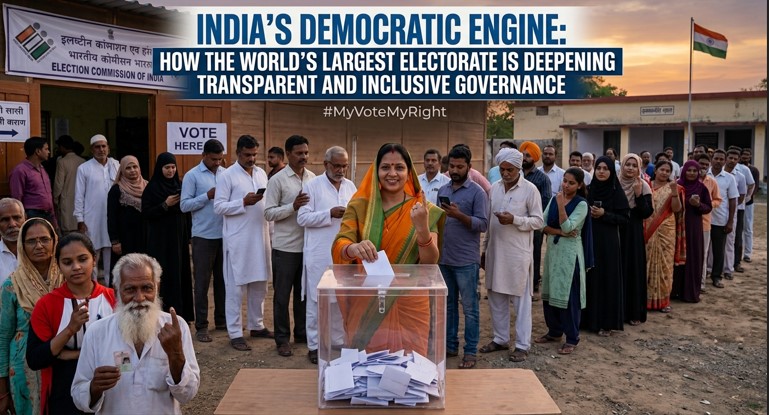
When nearly a billion citizens are eligible to vote, democracy stops being an abstract constitutional principle and becomes a vast exercise in organisation, participation and public trust.
In India, the scale of that exercise is matched by an increasingly technology-enabled electoral system, a constitutional election authority and an expanding effort to make the ballot accessible to citizens across age groups, regions and social backgrounds.
The world’s largest democracy has continued to evolve its electoral architecture since independence, combining universal adult suffrage with institutional safeguards, digital tools and voter-focused reforms.
The 2024 Lok Sabha election demonstrated the scale of this democratic participation, while developments through 2025 and 2026 have further emphasised transparency, accessibility and technology in election management.
A democratic exercise on an extraordinary scale
India’s electoral system now operates across an electorate approaching one billion.
The Election Commission of India’s Atlas for the 2024 Lok Sabha election recorded 97.98 crore registered electors, compared with 91.19 crore in 2019.
A total of 64.64 crore votes were polled in 2024, 3.17 crore more than in 2019. The overall voter turnout stood at 66.10 percent, compared with 67.40 percent five years earlier.
These figures place the Indian electoral process among the largest recurring exercises in democratic participation anywhere in the world.
The 2024 election also involved an extensive network of polling stations, election officials, candidates, security personnel and technological systems, bringing the constitutional principle of universal adult suffrage into practice across an exceptionally diverse population.
The scale is accompanied by a notable expansion in women’s participation. Women accounted for 48.62 percent of registered electors in 2024, up from 48.09 percent in 2019. Female voter turnout reached 65.78 percent, slightly higher than the male turnout of 65.55 percent.
The numbers underline how electoral participation has increasingly become a broad social exercise rather than one dominated by a single demographic group.
Transparency built into the electoral process
The Election Commission’s approach to transparency extends across voter registration, polling, counting and post-election procedures.
Its systems involve political parties and candidates at several stages, including the preparation and verification of electoral rolls, checking of electronic voting machines and Voter Verifiable Paper Audit Trail units, randomisation, commissioning, transportation, storage and counting.
Electronic voting machines are supported by VVPAT technology, which allows voters to see a printed slip showing the candidate they selected.
The slip remains visible for about seven seconds before automatically dropping into a sealed compartment. The system creates a physical audit trail alongside electronic vote recording.
The Commission has also expanded the use of digital monitoring. According to the Government’s National Voters’ Day 2026 backgrounder, 100 percent webcasting at polling stations has strengthened monitoring of poll-day activities.
The Commission has also developed digital systems for voter services, turnout reporting and election management, while cVIGIL enables citizens to report violations during elections.
Such measures reflect an important evolution in election administration: transparency is increasingly being designed into the process rather than treated solely as a post-election requirement.
Technology with the voter at the centre
The modern Indian election combines sophisticated technology with a deliberately simple experience for voters.
The ECI’s voter-turnout system allows poll-day data to be entered at regular intervals and disseminated through digital platforms, while constituency and polling-station-level final turnout information undergoes multi-level verification.
The Commission has also continued to improve the delivery of voter services. New procedures introduced in 2026 aim to deliver Electors’ Photo Identity Cards within 15 days of an update to electoral rolls, accompanied by SMS notifications.
Polling stations have also been managed with a maximum limit of 1,200 voters in order to reduce crowding and facilitate smoother participation.
The technological transformation therefore extends beyond the voting machine. It encompasses the entire electoral chain, from voter registration and information dissemination to monitoring, turnout reporting and post-election documentation.
Making democracy more inclusive
The strength of a democratic system is measured not only by the number of voters but also by how effectively it enables different sections of society to participate.
India’s electoral administration has increasingly focused on senior citizens, persons with disabilities, women, young voters and citizens living in remote locations.
President Droupadi Murmu, addressing National Voters’ Day in January 2025, highlighted the growing participation of women and the Election Commission’s efforts to facilitate voting for citizens aged above 85, persons with disabilities and tribal voters living in remote areas.
The same citizen-centric philosophy has continued into 2026. The theme of National Voters’ Day was “My India, My Vote”, accompanied by the tagline “Citizen at the Heart of Indian Democracy”.
The Election Commission has also used the SVEEP programme to expand voter education, awareness and electoral literacy, particularly among young citizens.
This emphasis on inclusion is significant because India’s democracy operates across enormous geographical, linguistic and social diversity. Bringing the ballot closer to citizens requires not only polling infrastructure but also sustained voter education and administrative outreach.
Democratic participation extends beyond elections
India’s democratic architecture is broader than the mechanics of voting. Constitutional institutions, Parliament, state legislatures, local bodies, political parties, civil society and an independent judiciary form part of the country’s wider system of representative governance.
The Bertelsmann Transformation Index 2026 describes India as having held competitive elections for nearly seven decades and notes that universal suffrage by secret ballot is firmly established.
It records the 2024 general election as the world’s largest democratic exercise, with more than 968 million eligible voters and turnout above 66 percent.
The report also notes that political representation extends to the local level and that India’s party system includes numerous national and state-level parties representing different ideological, regional and social interests.
This breadth of participation gives India’s democratic system a distinctly federal and plural character. National elections provide one layer of representation, while state and local elections allow political competition and public participation to operate closer to citizens.
From national electoral strength to global democratic cooperation
India’s electoral experience is increasingly finding an international dimension. In January 2026, the India International Conference on Democracy and Election Management brought representatives from more than 40 election-management bodies to New Delhi.
The conference concluded with the Delhi Declaration 2026, which identified electoral roll integrity, participatory and transparent elections, research, technology, and capacity building as key areas for international cooperation.
India has also positioned its election-management expertise as a resource for other democracies.
The ECI’s India International Institute of Democracy and Election Management has trained more than 10,000 Indian election personnel and officials from more than 100 countries over 15 years, according to the Government’s 2026 backgrounder.
The internationalisation of India’s electoral expertise reflects a broader shift. The country is not only managing elections on an unprecedented domestic scale but also sharing institutional experience, training and digital approaches with election-management bodies abroad.
A democracy continuously renewing itself
The story of India’s electoral democracy is ultimately one of scale combined with institutional adaptation.
From universal adult franchise at independence to electronic voting, VVPAT, digital voter services, webcasting, voter education and international electoral cooperation, the system has repeatedly incorporated new methods while retaining the central principle that political authority derives from the citizen’s vote.
The 2024 general election brought 64.64 crore votes into the democratic process. By 2026, the Election Commission was further strengthening voter services, digital monitoring, electoral-roll management and international cooperation.
The emphasis on women’s participation, accessible polling and voter education has added another dimension to that transformation.
President Murmu has described India’s democracy as a unique example for the modern world, while the Election Commission’s recent initiatives place the citizen at the centre of electoral administration.
These developments illustrate how the world’s largest democracy continues to expand the practical meaning of participation.
India’s democratic achievement lies not simply in conducting elections at extraordinary scale. It lies in the continuing effort to make the electoral process accessible, auditable, technology-enabled and participatory.