

Colombo’s New “Chinatowns” and the Triad Shadow: How Chinese Syndicates Caught Sri Lankan Authorities Napping to Fill the Underworld Vacuum

Walk down the bustling streets of Kollupitiya (Colombo 03), Bambalapitiya (Colombo 04), or along the neon-lit stretches of Marine Drive and Slave Island (Colombo 02), and the demographic shift is unmistakable. Mandarin signage towers over seaside cafés, hotpot restaurants, and exclusive supermarkets catering almost entirely to Chinese expatriates. Locals have begun half-jokingly referring to these pockets—alongside the high-rise enclaves abutting the Colombo Port City—as Sri Lanka’s unofficial “Chinatowns”. Yet behind the veneer of infrastructure investment and legitimate commerce, a darker reality is taking root.
As Sri Lankan law enforcement spent the past two years dismantling homegrown underworld gangs through aggressive island-wide crackdowns, transnational Chinese organised crime syndicates quietly moved in to occupy the vacuum. For years, Sri Lanka’s criminal landscape was dominated by local drug kingpins and extortionists. Following intensive police operations that saw local gang leaders neutralised or fleeing to Dubai, and over Rs. 4.5 billion in underworld assets seized, authorities believed they had broken the back of organised crime. Instead, they were caught napping by a far more sophisticated, tech-savvy menace: Chinese triad-linked syndicates relocating their cyber-fraud, cryptocurrency laundering, and extortion empires from Southeast Asia to the Indian Ocean.
At the epicentre of this crisis is the Colombo Port City. Designed as a premier Special Economic Zone with tax holidays and streamlined regulatory frameworks to attract foreign capital, the zone’s lax corporate vetting has reportedly been exploited by criminal networks. According to financial crime investigators, syndicates have registered dozens of shell companies under the guise of IT consultancies, BPOs, and offshore trading firms. These front companies serve a dual purpose: they launder illicit digital proceeds and act as visa factories, securing resident and business permits for hundreds of cyber-scam operatives to enter Sri Lanka without triggering immigration alarms.
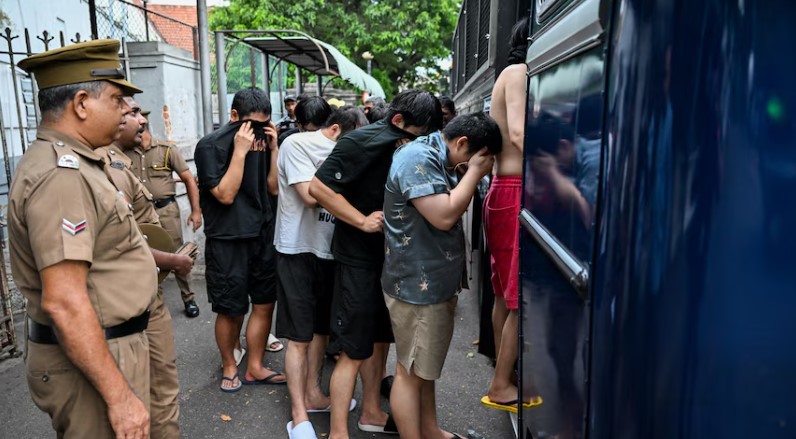
The sheer scale of this infiltration is backed by alarming enforcement statistics. After detaining 230 Chinese nationals for operating cybercrime hubs in 2024, the numbers have surged. Between March and May 2026 alone, a series of sweeping raids across Colombo, Negombo, and the southern coast netted over 320 foreign operatives—predominantly Chinese nationals—running fortified “pig-butchering” romance and investment scam compounds. In a single raid in Negombo, Police Special Task Force (STF) officers confiscated 402 mobile phones, 60 industrial routers, and 17,400 SIM cards. What began as invisible digital fraud has rapidly spilled into violent street-level turf wars and brazen extortion. In late July 2026, the illusion of peaceful coexistence shattered when a triad-style gang rivalry erupted right inside the Colombo Port City. Three Chinese nationals were ambushed by a rival Chinese syndicate; one victim was abducted in a van—where police later found an abandoned air pistol—and his body was subsequently discovered dumped in a forest area.
Just days ago, on October 13, 2026, officers from the Central Crimes Investigation Bureau (CCIB) and Colombo Crimes Division (CCD) arrested another Chinese syndicate operative in the Port City for running a high-stakes extortion racket targeting foreign investors. Police Spokesman ASP F.U. Wootler confirmed that officers recovered six passports—including four suspected forgeries—alongside 42 Dialog SIM cards, five mobile phones, and contraband cigarettes from his possession. “We spent years hunting local street thugs with pistols, completely blind to the fact that transnational syndicates were setting up billion-rupee digital command centres in luxury apartments,” a senior investigator attached to the Criminal Investigation Department (CID) admitted on condition of anonymity. “By the time the July Port City murder happened, we realised these weren’t just isolated visa overstayers. We are dealing with structured triad networks that use shell companies as shields, enforce discipline through abduction, and extort businesses right under our noses.” On the streets of Kollupitiya and Bambalapitiya, the rapid influx and unchecked impunity of these groups have left local Sri Lankans feeling like outsiders in their own neighbourhoods.
Residents and three-wheeler drivers report growing incidents of public harassment, aggressive brawls outside unregistered nightclubs, and intimidation by private security details guarding walled-off villas. “After 8:00 PM, whole lanes off Marine Drive feel like a foreign territory where our laws don’t apply,” says Nuwan Perera, a 42-year-old restaurant supplier in Kollupitiya. “A few weeks ago, a group of Chinese men blocked the road with their luxury vans and threatened a local delivery rider who honked at them. Several shops here refuse entry to locals altogether. When our own underworld gangs were pushed out, we thought Colombo would become safer—instead, we’ve traded local thugs for international syndicates who have the money to buy silence.” As the Sri Lankan government pivots from simple deportations to active prosecutions under the Computer Crimes Act and the Prevention of Money Laundering Act, law enforcement faces an uphill battle. Without urgent reforms to audit Port City shell companies and tighten business visa scrutiny, Colombo risks permanently cementing its status as South Asia’s newest safe haven for transnational organised crime.