

Hong Kong’s Democratic Spirit Under Siege: Beijing’s Iron Grip and the Looming Economic Fallout

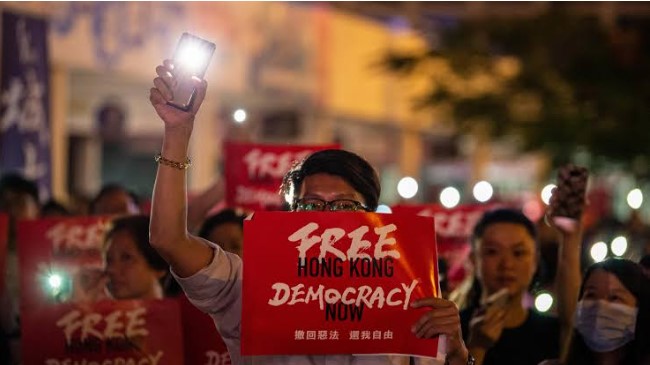
Hong Kong, once hailed as Asia’s most vibrant financial hub and a symbol of freedom, is now enduring an unprecedented assault on its democratic foundations. Since the imposition of the National Security Law in 2020, the Chinese Communist Party (CCP) has tightened its grip on the city, systematically dismantling civil liberties and punishing pro‑democracy activists. The recent convictions of figures such as Joshua Wong, Chow Hang‑tung, Lee Cheuk‑yan, and Albert Ho highlight Beijing’s determination to silence dissent and reshape Hong Kong’s governance to mirror its authoritarian model.
The CCP’s strategy is deliberate and ruthless. Activists have been charged with vague offenses like “collusion with foreign forces” and “incitement to subversion,” often applied retrospectively to actions that were lawful before the national security law came into effect. This judicial weaponization has created a chilling effect, where even peaceful advocacy for democracy or human rights is treated as criminal. Wong, once the face of Hong Kong’s youth led democracy movement, now faces the grim prospect of spending the rest of his life behind bars. His case epitomizes how Beijing is using the law not to protect security but to eliminate opposition voices.
Beyond individuals, the crackdown has devastated Hong Kong’s civil society. Independent media outlets such as Apple Daily have been forced to close, journalists face sedition charges, and NGOs have dissolved under relentless legal pressure. The city’s once vibrant political landscape has been hollowed out, leaving only voices sanctioned by Beijing. This erosion of pluralism is not just about silencing activists; it is about erasing Hong Kong’s unique identity as a semi‑autonomous city with freedoms distinct from mainland China.
Yet Beijing’s campaign carries enormous economic risks. Hong Kong’s economy, valued at $5 trillion, thrives on openness, rule of law, and international trust. These qualities made it a magnet for global capital, expatriates, and multinational corporations. But as the CCP reshapes the city’s governance, foreign enterprises are increasingly wary. Major firms have already shifted operations to Singapore and Tokyo, citing political instability and legal unpredictability. Housing prices have slumped, foreign investment has slowed, and tens of thousands of skilled professionals have emigrated, draining the city’s talent pool. If Beijing continues to alter Hong Kong’s governance pattern, the city risks losing its international flavour, the cosmopolitan character that made it indispensable to global finance. Expatriates and foreign enterprises may flee, undermining Hong Kong’s role as a neutral gateway for capital. In essence, the CCP is trading Hong Kong’s prosperity for political dominance, a gamble that could permanently downgrade the city’s global standing.
The international community has taken notice. The United States and United Kingdom have imposed sanctions on Hong Kong officials and revoked the city’s special trade status. Human rights organizations have condemned the retrospective application of laws, calling it illegitimate and a violation of international agreements such as the Sino‑British Joint Declaration. Diplomatically, Hong Kong has become a test case for China’s broader ambition to export authoritarian governance beyond its borders.
What Beijing fails to realize is that authoritarian consolidation cannot manufacture trust, innovation, or international appeal. By crushing dissent, the CCP may secure short‑term control, but it undermines the very foundations of Hong Kong’s prosperity. The city’s reputation as a free, cosmopolitan hub is fading, and its role as Asia’s financial heart is at risk.
Hong Kong now stands at a crossroads. The CCP’s iron fist may silence activists, but it cannot erase the global awareness of what is happening. Unless Beijing recalibrates its approach, Hong Kong risks becoming a tightly managed provincial outpost rather than a global powerhouse. Defending Hong Kong’s freedoms is not just about democracy, it is about safeguarding the economic and cultural vitality of one of Asia’s greatest cities.
The world must recognize that Hong Kong’s struggle is not isolated. It is a warning of how authoritarian regimes can dismantle freedoms while jeopardizing economic stability. If Beijing continues down this path, Hong Kong’s decline will serve as a cautionary tale: prosperity cannot coexist with repression. The city’s international flavour, its openness, and its diversity are its lifeblood. Without them, Hong Kong risks becoming just another city under Beijing’s shadow, stripped of the qualities that once made it extraordinary.
References:
https://www.hongkongfp.com/2026/09/07/hong-kong-national-security-crackdown-month-74
https://apnews.com/article/hong-kong-tiananmen-vigil-activists-sentenced-2026
https://www.rfi.fr/en/hong-kong-tiananmen-vigil-activists-convicted-2026