


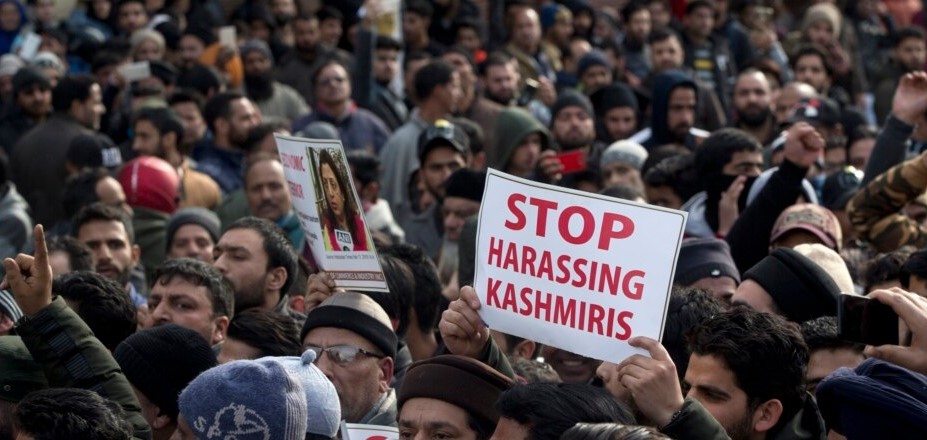
There are different ways to deal with people who protest for their demands, which often lead to violence. But no government in the world may have ever declared civilians as terrorists for seeking their basic rights. Pakistan has done. It labelled hundreds of Kashmiris as a threat to national security. What they did. They only demanded better governance and a reduction in the food prices. Islamabad criminalised rights by weaponising the anti-terrorism laws.
What did Kashmiris do to be lebelled as terrorists? They held peaceful protests. The organisation that led the public movement was linked to terrorism. Jammu Kashmir Joint Awami Action Committee (JKJAAC) was proscribed under the Azad Jammu and Kashmir Anti-Terrorism Act, 2014. This was big. Because this act contains provisions to place individuals associated with organisations suspected of terrorism or sectarianism.
One must understand how severe and long-lasting the impact on the Islamabad government’s draconian decision had on the peaceful protesters.
Ordinary Kashmiris were placed on the Fourth Schedule, which means the consequences can be severe even without a criminal conviction. The civilian-military hybrid government did not have reasonable grounds to justify its action of targeting innocent people and calling them a national security threat.
This shows the intentions of Islamabad was not just to contain the protests in Kashmiris. Else, the JKJAAC and its members and average Kashmiris who participated in the agitations would not have been placed on the Fourth Schedule. It has created severe problems for those being on the Fourth Schedule, such as restrictions on movement, suspension of banking services and passports, and subjection to police monitoring and surveillance.
The suspension of national identity cards may have barred many Kashmiris from accessing banking services, government facilities and employment opportunities. This amounts to social and economic punishment without any conviction or even prosecution. Kashmiris were forced to report to police stations frequently, even as they were subjected to constant monitoring, resulting in breach of their privacy and great mental harassment. Just imagine the plight of poor and innocent Kashmiris. The illegal and unethical action of the government did not target the JKJAAC but also ordinary Kashmiris.
The United Nations and other international human rights organisations have expressed serious concerns over Pakistan’s undemocratic, rather autocratic, action. The UN told Islamabad that its action may have violated international laws as the group it proscribed was fighting for its political, labour and human rights campaigning.[1] The UN said it was “alarmed” by the Pakistan government’s decision to put 205 people on the Fourth schedule. They included traders, lawyers, transport workers and civil society activists.[2] Shockingly, there were women among these people, whose identity cards were suspended and medical treatment rejected.
How can a government do such things to its own people? Were these people convicted? No. No wonder, the UN demanded answers from Islamabad over questions ranging from the reasons for proscription of the JKJAAC and the listing of 205 people, to the suppression of basic rights, and the excessive use of force on peaceful protestors. The JKJAAC now has demanded immediate action against unlawful killings, the violent crackdown and arbitrary arrests, restrictions on communications, and deprivation of medical care.[3]
Now, more disturbing information is coming out. Not 205, but 445 entries were made, which included overseas residents and even a four-year-old on the Fourth Schedule by the state of Pakistan. UK-based Jammu Kashmir Human Rights Observatory (JKHRO) said it raised serious questions about transnational repression and the consequences of security classifications for lawful diaspora advocacy.[4] JKHRO also revealed the deaths of 102 Kashmiris in relation to the repression activities by Pakistani law enforcement agencies in the past few months.
In short, the state of Pakistan sent a strong and direct message to its people that holding protests against the government, no matter how legitimate and righteous their demands be, could translate into inhuman punishment by exposing them to the machinery of counterterrorism legislation. Irony died a thousand times. For a country that regularly invoked political aspirations and self-determination of Kashmiris internationally, this kind of ill-treatment in Pakistan-administered Kashmir presents an uncomfortable contradiction. It exposed Islamabad’s lies, deception, and the gap between its international rhetoric and domestic practices.
Now, the international community has seen how the measures taken by Islamabad extended far beyond maintaining law and order. They disrupted livelihoods, restricted political participation and rendered huge mental and physical violence against peaceful protestors. The larger question is whether Pakistan-administered Kashmir enjoys meaningful political autonomy. The clear answer is no. For those sitting in power, people seeking their rights are a national threat.
END.
[1] https://spcommreports.ohchr.org/TMResultsBase/DownLoadPublicCommunicationFile?gId=31223
[2] https://voicepk.net/2026/11/un-experts-warn-terror-listing-of-jaac-violates-international-law/
[3] https://jkjaac.co/jkjaac-welcomes-un-experts-concerns-over-proscription-and-calls-for-immediate-action-to-protect-fundamental-rights
[4] https://jkhro.org/pakistan-administered-jammu-and-kashmir-jkhro-documents-445-reported-fourth-schedule-listings