


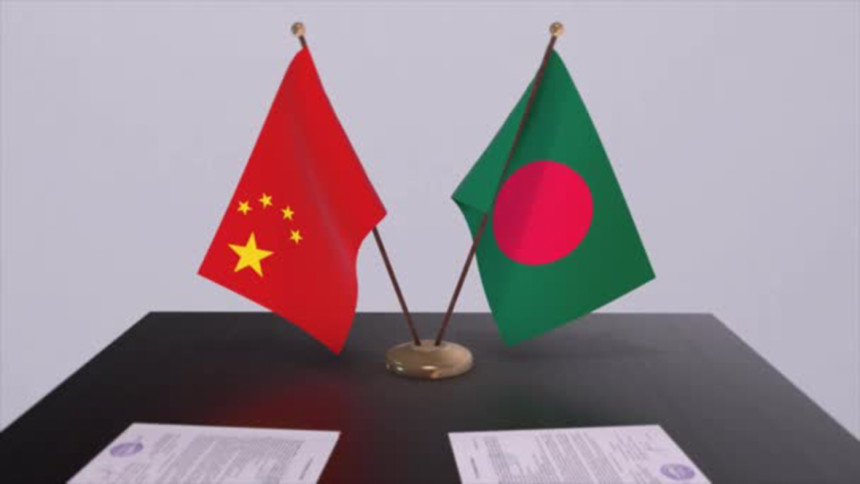
Bangladesh has slipped into a debt trap. The confirmation has come from none other than Chairman of the National Board of Revenue of Bangladesh M. Abdur Raman Khan. In a way, this is not a surprising development. Bangladesh has gone the same way as its South Asian neighbours like Sri Lanka, having become a partner of the Belt and Road Initiative of China and paid the price for it.
Debt servicing has emerged as the second largest budget expense for Bangladesh. The debt-to-GDP ratio of Bangladesh has climbed to over 39 percent from about 34 percent in 2017-18. “We have already fallen into a debt trap,” the Chairman of the National Board of Revenue warned while speaking recently at a seminar. “Without acknowledging this truth, it is not possible to move forward.”
Quite surprisingly, leading financial authorities, while speaking at the seminar, have been verbose with the malady of the financial situation facing the Bangladesh government, but they seem to be powerless to do anything to remedy it.
Leading economist Mustafizur Rahaman for instance has regretted that agriculture and education used to be the second largest expenditure in the revenue budget for Bangladesh after salaries and pensions; but no longer so. Finance Secretary M Khairuzzaman Mozumdar has said the national budget of Bangladesh for the current year, for the first time in the history of the country, has been smaller than in the previous year. It is like a “thin man has been asked to lose even more weight,” he has observed pithily.
The World Bank has hit the nail on the head with its International Debt Report 2025. It shows that the external debt of Bangladesh has jumped 42 percent over the last five years, with total foreign borrowing reaching nearly $105 billion by the end of 2024, up from $26 billion in 2010. External debt now stands at 192 percent of the export earnings of the country, with debt service payments surging to 16 percent of exports; signalling growing pressure for repayment.
In view of the increased dependence of Dhaka on the Belt and Road Initiative of China, it is no wonder that Bangladesh is slipping into a debt trap the way Sri Lanka had. Following unsustainable borrowings from China, in 2022 Colombo was pushed to a situation of sovereign debt default; followed by an economic meltdown. Pakistan has sought $7 billion from the Extended Fund Facility of the IMF to repay Chinese debts. Under the China Pakistan Economic Corridor, Islamabad owes to China nearly $30 billion.
Now after a decade of exposure to BRI investments, Bangladesh expects to receive a total of $40 billion from China, of which $14 billion in joint venture projects between the two countries. Back in 2022, when Bangladesh owed a debt of $4 billion to China, then Finance Minister of Bangladesh Mustafa Kamal had expressed concern over the risks associated with BRI loans; poor lending practices of China and overwhelming indebtedness. Now within the next three years the total external debt burden of Bangladesh to China has surged to $7 billion.
Bangladesh formally joined the BRI in 2016 following President of China Xi Jinping’s visit to Dhaka. At that time Awami League was in power but Sheikh Hasina had been circumspect about the terms of Chinese loans. She had snubbed China by rejecting the claim of Beijing that the newly constructed $3.6 billion bridge on river Padma was a BRI project and had made it clear that as a symbol of national pride the bridge had been funded entirely by Dhaka.
Under the leadership of Mohammed Yunus as Chief Advisor of the Interim Government, however, Bangladesh has deepened its relationship with China. After his appointment, China was the destination of his first official visit to a foreign country in March 2025. The visit resulted in Bangladesh securing $1.2 billion in investments and grants from China; bringing the total Chinese investments in Bangladesh to over $42 billion in 2024-25. In a meeting with President Xi Jinping, Mohammed Yunus even suggested that Chinese companies shift their manufacturing bases to Bangladesh.
Beijing has, however, not placed all their eggs in one basket. Aware that the interim government is a temporary arrangement, China has been engaging steadily with other power centres that are gaining ground in Bangladesh, among them Jamaat-e-Islami; a fundamentalist pro-Pakistan organization that is said never to have criticized Beijing for its treatment of the Uighur minorities.
In December 2024, leaders of Islamist political outfits in Bangladesh, led by Nayeb-e-Ameer of Jamat Syed Abdullah Mohammed Taher, toured China at the invitation of the Chinese Communist Party. In September 2024, the visit of Chinese Ambassador to Bangladesh Yao Wen to the Jamaat office in Dhaka was the first such visit by a foreign diplomat since 2010. In July 2025, the Chinese Embassy in Dhaka arranged a reception for leaders of the Islamist parties. In September 2025, a delegation from the Chinese People’s Institute of Foreign Affairs had a meeting with leaders of the Jamaat-e-Islami.
China has used the BRI to gain strategic ground in countries which have signed on the dotted line. It is not surprising that Islamist groups in Bangladesh are now campaigning for more Chinese investments in the country. On October 19 this year, the Islami Chhatra Shibir, the student wing of the Jamaat, held a big rally at the Chittagong University demanding the interim government accept the Chinese proposal of Teesta River Comprehensive Management and Restoration Project.
The Teesta project is located in the northern part of Bangladesh close to the sensitive Siliguri corridor in north-east India. China would like to establish its presence in this strategic area in its long-term interest of gaining access to the Bay of Bengal. With the same end in view, China has also offered Bangladesh a loan of $336 million under the BRI for the development of the Mongla Port. There is already a conjecture if the Chittagong Port would become an important link in China’s “string of pearls” in the Indian Ocean region.
“While Chinese investments have accelerated infrastructure development, they have also increased Bangladesh’s debt burden and dependency on China. The strategic placement of investments suggests potential geopolitical motivations behind Chinese funding,”an article from the Bangabandhu Sheikh Mujibur Rahman Science and Technology University, Gopalganj, appearing in the International Journal of Applied Research and Sustainable Sciences in November 2024 said.
Thus, Dhaka is paying the price of accepting Chinese loans, but refusing to learn.