


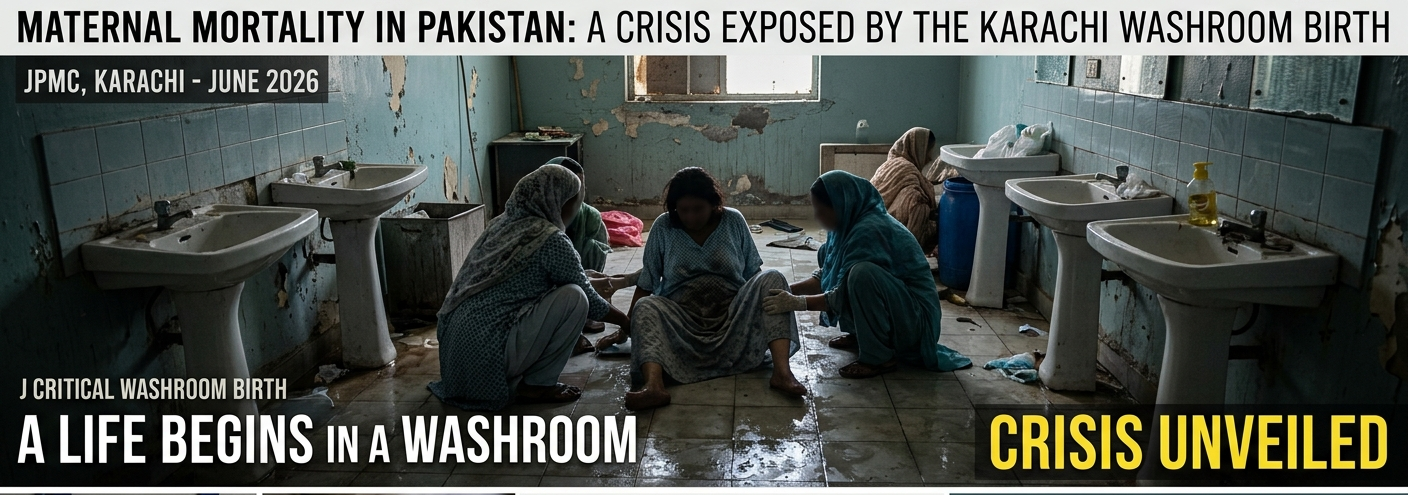
A recent childbirth incident at Karachi’s Jinnah Postgraduate Medical Centre (JPMC) unfolded in a sequence that starkly illustrates the fragility of maternal care in Pakistan. A woman in labour arrived at the hospital but was denied an ultrasound examination and advised merely to walk around. Left without proper monitoring or medical assessment, she ultimately delivered her baby in a hospital washroom. When videos of the incident went viral on social media, they sparked widespread public concern and criticism of patient care standards at one of Sindh’s largest public-sector hospitals. The outrage compelled the Sindh Health Department and JPMC administration to constitute a three-member inquiry committee to investigate the circumstances and determine negligence on the part of hospital staff.
As per the inquiry committee’s findings the patient was advised to “walk around” instead of being properly assessed, that no ultrasound was performed, and that the resident medical officer was absent from duty. These expose not only negligence but also the systemic weaknesses that continue to plague the country’s healthcare system. This single case, amplified by viral videos and public outrage, is emblematic of a broader crisis in maternal health that Pakistan has struggled to address despite decades of policy frameworks and international commitments.
Despite being a signatory to Agenda 2030 and pledging to achieve the Sustainable Development Goal of reducing maternal mortality to 70 deaths per 100,000 live births by 2030, Pakistan continues to fall short. Each day, 27 mothers die from preventable complications, alongside 675 newborn deaths. Annually, this amounts to nearly 9,800 maternal deaths, 246,300 newborn deaths, and more than 190,000 stillbirths. The maternal mortality ratio remains far above global targets: 104 deaths per 100,000 live births in Azad Jammu and Kashmir, 157 in Gilgit-Baltistan, and a troubling disparity between rural areas, where the rate is 199, and urban areas, where it is 158. These figures reveal not only the scale of the crisis but also the deep inequalities that leave rural women disproportionately vulnerable, often dying while traveling long distances to reach hospitals in cities.
Maternal mortality in Pakistan remains among the highest in South Asia. The leading causes of maternal deaths in Pakistan are well documented and largely preventable. Postpartum hemorrhage is the most common, worsened by shortages of blood supplies in hospitals. Puerperal sepsis, or blood poisoning caused by untreated infections, continues to claim lives due to inadequate access to antibiotics. Eclampsia, marked by high blood pressure and convulsions, is another major killer. Indirect causes such as anaemia, which affects nearly 42 percent of women of reproductive age, further weaken maternal health. These medical risks are compounded by the “three delays”: delay in deciding to seek care due to ignorance or reliance on traditional midwives; delay in reaching hospitals caused by lack of transport and ambulance services; and delay within hospitals themselves, where untrained staff, shortages of supplies, and poorly organized emergency services prevent timely intervention. The JPMC case illustrates this vividly; a woman in active labour was denied basic diagnostic care and left to wander the ward, ultimately delivering her baby in a washroom.
Pakistan’s healthcare system is structurally underfunded, with the country spending less than one percent of its GDP on health. Government hospitals are chronically short of doctors, nurses, and beds, and most regular staff members are postgraduate trainees with limited experience in handling obstetric emergencies. Rural women, in particular, lack access to essential facilities, and many die during arduous journeys to far-off hospitals. These systemic deficits mean that even when women reach hospitals, they are not guaranteed timely or competent care. The inquiry committee’s recommendation to extend training periods and initiate disciplinary proceedings against negligent staff reflects an attempt at accountability, but the larger picture remains one of institutional fragility and neglect.
On World Health Day 2025, the World Health Organization called on Pakistan and its partners to urgently invest in reducing maternal and newborn deaths, stressing that these losses are preventable and that their persistence undermines the country’s prosperity and development. Yet progress has been slow, hindered by weak governance, poor planning, and social constraints that limit women’s access to healthcare. The persistence of high maternal mortality rates, despite decades of national frameworks and international commitments, underscores Pakistan’s failure to translate policy into practice. The Karachi washroom birth is not merely an isolated scandal; it is a microcosm of this broader failure. It demonstrates how negligence at the individual level intersects with systemic underinvestment and institutional weakness to produce tragedy.