


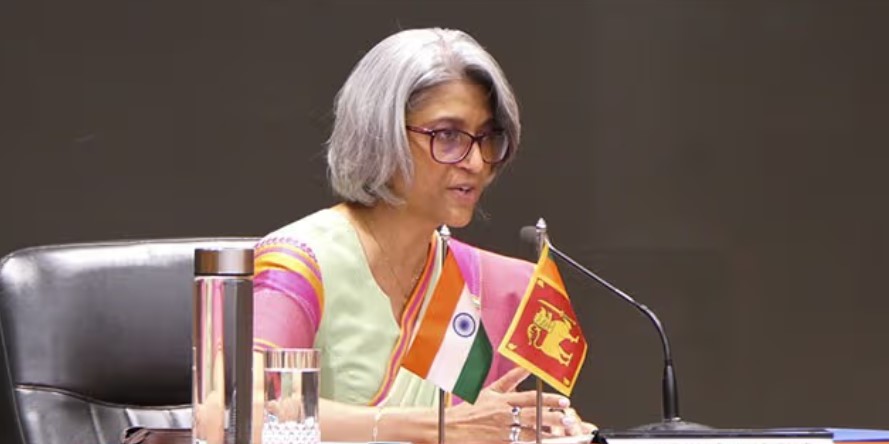
Sri Lanka’s High Commissioner to India Mahishini Colonne has emphasised the need to deepen Sri Lanka–India relations while safeguarding Sri Lanka’s sovereignty, territorial integrity and strategic autonomy.
Addressing the 66th Course of India’s National Defence College (NDC), High Commissioner Colonne spoke on “India–Sri Lanka Bilateral Relations: Determinants, Status, Opportunities, Challenges and the Way Forward.”
She had also addressed the 65th Course of the NDC in August 2025.
The lecture was attended by 122 senior officers from the Indian Armed Forces, Civil Services, Indian Police Service and other organs of the Government of India, together with 41 officers from foreign countries, including Sri Lanka.
Drawing on the NDC motto, “Wisdom is Strength,” High Commissioner Colonne examined the bilateral relationship through history, geography, sovereignty, security, economics, connectivity and people-to-people ties.
She highlighted the deep civilisational links between the two countries while also acknowledging more challenging periods in their modern relationship.
The High Commissioner pointed to the growing momentum in bilateral engagement, including President Anura Kumara Disanayaka’s State Visit to India in December 2024, Prime Minister Narendra Modi’s visit to Sri Lanka in April 2025, and the first-ever bilateral visit to Sri Lanka by an Indian Vice President in April 2026.
She also highlighted India’s humanitarian assistance to Sri Lanka following Cyclone Ditwah in November 2025 through Operation Sagar Bandhu.
Strategic interests and sovereignty
Addressing the strategic dimension of the relationship, High Commissioner Colonne stressed the interdependence between India and Sri Lanka.
She reiterated Sri Lanka’s consistent assurance that its territory would not be used in a manner that threatens India’s security interests, while emphasising the importance of protecting Sri Lanka’s sovereignty, territorial integrity and strategic autonomy.
The High Commissioner also recalled India’s significant assistance to Sri Lanka during the 2022 economic crisis, including critical emergency support and India’s role as the first bilateral creditor to provide financing assurances for Sri Lanka’s IMF programme.
Speaking about the inherent asymmetry between the two countries, Colonne said this should not translate into domination or vulnerability.
She described the relationship as “a partnership between unequal states, but not between unequal interests,” noting that both countries share fundamental interests in peace, stability, prosperity and security in the Indian Ocean.
Six priorities for the future
The High Commissioner outlined six priorities for further strengthening the bilateral partnership: building mutual trust; strengthening the partnership and shared prosperity; accelerating connectivity; developing an integrated maritime security partnership; investing in people; and exploring areas where India and Sri Lanka can work together for the wider Indian Ocean region.
Her remarks also covered trade and investment, energy cooperation, defence and security ties, maritime cooperation, digital connectivity and the Colombo Security Conclave.
High Commissioner Colonne highlighted public goodwill as an important strategic asset in the relationship, referring to a Pew Research Centre survey published on August 13, 2026. According to the survey, 79 per cent of Sri Lankans expressed a favourable view of India, the highest such rating among the 36 countries surveyed.
Following the address, the High Commissioner participated in an interactive question-and-answer session with NDC course participants.
She also addressed a delegation of officers who will undertake the NDC’s Study Tour of Sri Lanka from August 31 to September 2, 2026.
Established in 1960, the National Defence College is India’s apex institution for the study of national security and strategy. Its 47-week programme brings together senior officers from the Indian Armed Forces and Civil Services, as well as officers from friendly foreign countries.
Sri Lanka has been sending senior officers and officials to the National Defence College for more than five decades, underscoring the longstanding defence and strategic relationship between the two countries.