


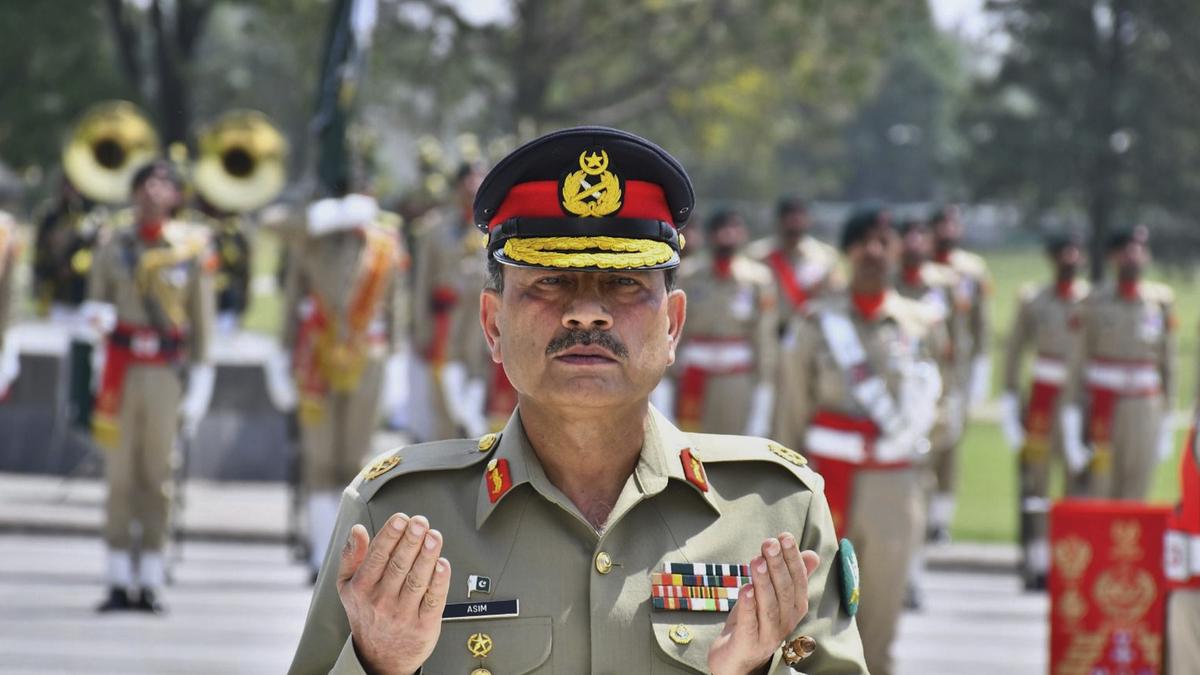
Pakistan’s politics has entered a new phase of open military dominance. The recent 27th Constitutional Amendment gives unprecedented powers and legal protection to Field Marshal Asim Munir and the army leadership. Civilian institutions, including parliament and the judiciary, are now even weaker. This is not only a domestic crisis. It is likely to destabilize South Asia in four ways. It raises the risk of conflict with Afghanistan. It hardens Pakistan’s posture toward India. It deepens internal insurgencies that can spill across borders. And it pushes Pakistan to lean more on the United States, potentially sharpening tensions with Iran.
The 27th amendment formalizes Pakistan’s “hybrid” rule in which elected governments operate under military tutelage. Munir will hold the new post of Chief of Defense Forces for at least five years, with primacy over the other services and full command of Pakistan’s nuclear force. He also enjoys lifetime immunity from prosecution. This change “decisively shifts the dial” toward authoritarian rule in Pakistan and gives the army chief the time and tools to shape future elections and security policy.
This centralization happens at a moment of rising violence. Pakistan faces a resurgent Tehreek-e-Taliban Pakistan (TTP) in Khyber Pakhtunkhwa and Baloch insurgency in the southwest province. Extremist groups have escalated attacks, including train hijackings, suicide bombings, and raids on security convoys. Marginalized ethnic groups like Baloch and Pashtuns are seeing radicalization among the youth due to years of human rights violations, extrajudicial killings, and torture carried out in the name of military operations. Several human rights groups have condemned unconstitutional arrests and violence against people from these ethnic communities, warning that such repression will fuel more anger and militancy in Pakistan.
Pakistan’s army has long used coercive tactics in Balochistan and former tribal areas. Recent reporting describes a “dirty war” of enforced disappearances, torture, and killings in Balochistan, which has driven many young people into the arms of insurgent groups. Human rights groups now warn that the new constitutional setup will entrench impunity for the security forces and further weaken avenues for peaceful dissent. Amnesty International and UN experts both document systematic attacks on Baloch activists and protests, calling for the release of detained human rights defenders and an end to violent crackdowns.
Relations between Kabul and Islamabad have sharply deteriorated since the Taliban’s 2021 takeover. Pakistan accuses the Taliban of sheltering and supporting the TTP. The Taliban reject these allegations and accuse Pakistan of cross-border air strikes and misinformation campaign against them. Recent incidents of repeated heavy exchanges of fire along the Afghanistan-Pakistan border, with artillery and mortars killing several innocent civilians and fighters on both sides. A ceasefire brokered in Qatar has already come under strain, and talks hosted by Qatar, Turkey, and Saudi Arabia have failed to produce a lasting deal.
In this environment, an army chief who promises to turn Pakistan into a “hard state” is more likely to use force than diplomacy. The new constitutional powers reduce civilian leverage to
push for restraint or to manage crises quietly. Military leaders also face incentives to appear tough on Afghanistan to deflect domestic criticism and project strength. This combination increases the risk that another border clash, a cross-border airstrike by Pakistan, or a TTP attack could spiral into a wider and longer conflict along the border.
India-Pakistan relations remain crisis-prone, and the May 2025 “Four-Day Conflict” showed how fast they can escalate. Munir emerged from that crisis claiming political credit inside Pakistan. His promotion to five-star rank and his control over the Strategic Plans Division now give him both prestige and hard power. He has adopted a more strident tone toward India, warning of responses “beyond proportion” to even minor provocations. With longer tenure and legal immunity, he can afford to take a more confrontational stance on incidents of cross-border terrorism or violence along the Line of Control.
If the Pakistan army chooses calibrated escalation to rally domestic support or to distract from internal political dissent, India will respond militarily, as it did in 2016, 2019, and now 2025. Each crisis may stay below the nuclear threshold, but the cumulative effect is a more unstable and militarized South Asia.
On the other hand, the United States still sees Pakistan as an important, if difficult, security partner. Washington still believes in Pakistan’s geostrategic value and calls for continued US engagement on counterterrorism and regional crisis management. In a more militarized Pakistan, army leaders will try to leverage this role. They can present themselves in Washington as indispensable partners against terrorism and as the only actors able to prevent nuclear escalation in South Asia.
Any renewed US military footprint in or around Pakistan, even in the form of overflight rights, intelligence facilities or drone access, will alarm both the Afghan Taliban and Iran. When reports surfaced in 2021 that Washington might seek bases in Pakistan after its Afghanistan withdrawal, the Taliban publicly warned Islamabad against hosting US troops.
Tehran also suspects that the renewed ties between the U.S. and Pakistan could pose a threat to its own security. More importantly, if the Pakistan military encourages closer security ties with the US, Iran may respond with its own pressure tools. These include cross-border strikes, support to Pakistani Shia groups, or closer coordination with the Taliban and other actors. The region could see a complex web of proxy dynamics centered on Pakistan’s restive western borderlands.
Pakistan’s deeper militarization is creating a “fortress Pakistan” mindset at a moment of intense regional volatility. On the western front, it raises the chance that border clashes with Afghanistan will turn into a protracted conflict driven by the TTP issue. On the eastern front, it entrenches a confrontational posture toward India in the wake of a near-war. Inside Pakistan, it fuels anger in Balochistan and Khyber Pakhtunkhwa, pushing more people toward armed struggle and expanding cross-border militant networks. And at the international level, it may draw the United States and Iran into sharper competition in and around Pakistan. The net effect is a more unstable South Asia where crises are more frequent, conflicts are more intertwined, and civilian voices for de-escalation are weaker.