


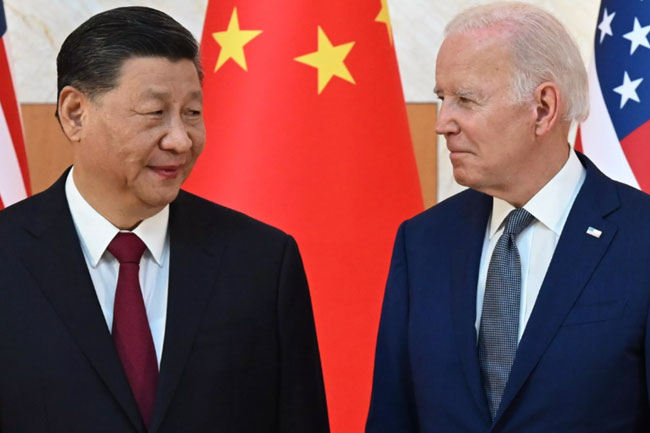
United States President Joe Biden and Chinese President Xi Jinping will try to stop the superpowers’ rivalry from spilling into conflict when they meet for the first time in a year at a high-stakes summit in San Francisco on Wednesday.
With tensions soaring over issues that include Taiwan, sanctions and trade, the leaders of the world’s two largest economies are expected to hold at least three hours of talks at a country estate on the outskirts of the Californian city.
The carefully choreographed meeting on the sidelines of the Asia-Pacific Economic Cooperation (APEC) summit in California is due to start with a formal handshake at 10:45 a.m., followed by bilateral talks behind closed doors that include a working lunch.
The 80-year-old Biden held out an olive branch to Xi, 70, on the eve of the talks, insisting that the United States was “not trying to decouple from China” and wanted to improve the relationship.
But the US leader could not resist adding later at a fundraising dinner that, under communist Xi, China faced “real problems,” while Biden claimed to be “reestablishing American leadership in the world.”
China responded with a Foreign Ministry spokeswoman pointing out all countries had problems, including the US, while sticking to positive talking points on the summit.
“The key to stabilizing and improving China-US relations is both sides working together, and the most fundamental condition is mutual respect,” ministry spokesman Mao Ning said.
The two leaders have not met in person since they held talks on the sidelines of the Group of 20 summit on Indonesia’s resort island of Bali in November 2022, and relations nosedived after the US shot down an alleged Chinese spy balloon in February this year.
The talks also come against the backdrop of a long struggle for global primacy between the US and an increasingly assertive China.
One of the most sensitive issues is Taiwan, the self-ruling democratic island over which Beijing claims sovereignty and which it has not ruled out seizing by force.
Biden is expected to warn China not to interfere in elections that will be held in two months in Taiwan, arguing that it would raise tensions.
“This is a complex relationship, a competitive relationship, that could easily veer into conflict or confrontation if it’s not well managed,” US National Security Adviser Jake Sullivan said on Monday.
Beijing and Washington have been locked in a flurry of high-level diplomacy in recent months that resulted in the announcement less than a week before the summit that Xi was coming.
Announcements not expected
Expectations of major announcements are low, but the two countries have trailed a series of possible wins from Xi’s first visit to US soil since he was hosted by then-president Donald Trump in 2017.
One of Biden’s “key objectives” is the restoration of the two countries’ military hotline, which Beijing severed after then-House speaker Nancy Pelosi visited Taiwan in August 2022, a senior US administration official said.
There were also hopes of “progress” on cooperation to limit Chinese exports of ingredients for fentanyl, the drug that has devastated American cities, including San Francisco, the official added.
The two leaders were additionally expected to discuss the wars in Israel and Ukraine, in which the two governments find themselves backing opposing sides, adding to global tensions.
On the eve of the summit, Beijing and Washington also pledged to work more closely together on global warming, declaring in a joint statement that the climate crisis was “one of the greatest challenges of our time.”
For his part, Xi is expected to push for an end to trade curbs and sanctions, with the Chinese economy struggling to shore up growth after its tough zero-Covid policy.
The Chinese leader will host a dinner with US executives after the summit “to send a message that China is still a good place to invest,” the US official said.
Biden and Xi both landed on Tuesday in San Francisco, where thousands of people lined the streets waving the red and gold flags of China and carrying banners welcoming the Chinese leader.
Source: AFP